

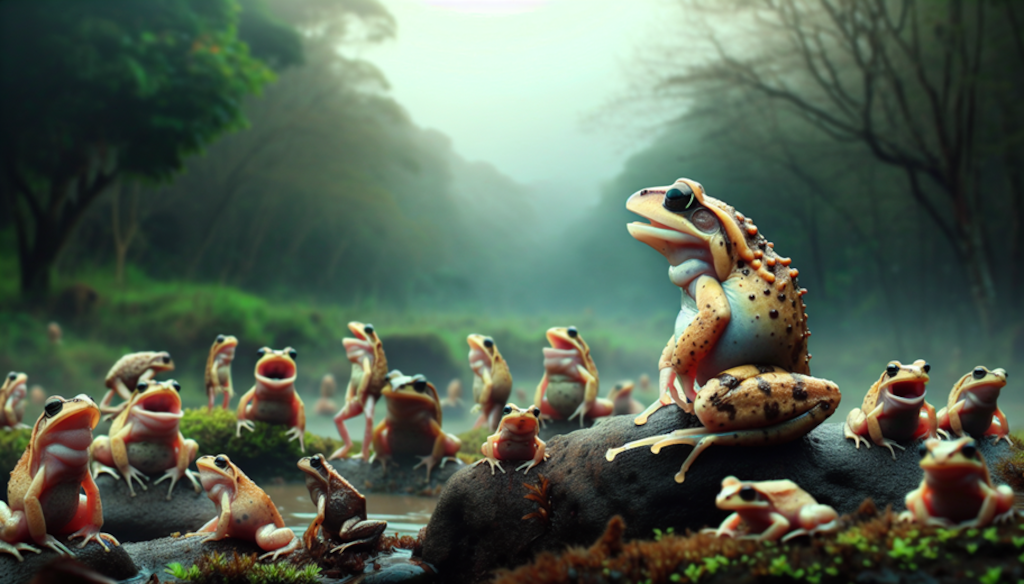
You’re probably familiar with the magical moment when a tadpole turns into a frog—tail gone, legs ready, the full leap from water-world munchkin to hopping amphibian. But what if that tail never vanished?
Imagine a frog. Fully grown. Croaking like the rest. Except… it’s still got its tail. No, it’s not a sci-fi mutation or Photoshopped oddity. It’s real. And it turns out, this tail-holding defiance of nature isn’t just a rare mistake—it’s a window into how genes and hormones shape transformation at its core.
The case of the “tailed frogs”
This strange phenomenon has been most clearly documented in Xenopus frogs (the species scientists love for developmental studies). In certain experiments, froglets that should’ve ditched their tails during metamorphosis just… didn’t. And researchers eventually found the culprit: a gene called thyroid hormone receptor beta (TRβ).
Normally, during metamorphosis, a surge of thyroid hormones tells tadpole tissues it’s time to either adapt or disintegrate (goodbye, tail!). But in frogs with a loss-of-function mutation in TRβ, this message never gets delivered properly. So the tail lingers. Sometimes for weeks. Sometimes into full adult life.
How scientists created tailed frogs on purpose
In a groundbreaking study, researchers created TRβ-knockout frogs—that is, frogs genetically engineered to lack a functioning TRβ gene. Here’s what happened:
- The rest of the body metamorphosed like usual.
- Legs grew. Lungs formed. Skin adapted.
- But the tail? It just… stayed.
Not just a tiny stub, either. Substantial tail tissue remained in healthy, otherwise-normal adult frogs. You can think of it like a forgotten suitcase on evolution’s train ride—left behind while the rest fully transitioned.
But why does this happen?
It all comes back to thyroid hormone (TH) signaling. This delicate chemical sequence is like a master conductor setting the tempo for transformation. Here’s what scientists discovered:
- Blocking TH synthesis chemically (with drugs) also delayed tail loss—in essence, mimicking the TRβ problem.
- Overproducing certain genes like prolactin (yes, the same hormone associated with milk production in mammals) similarly screwed up the timing of tail resorption.
- Mutating helper proteins like SRC3, which assist TRβ in doing its job, had similar “tailed” outcomes.
What didn’t work? Knocking out other genes like ouro1 and ouro2, which were once assumed to be part of the process. Turns out, they didn’t have much impact. Same for frogs with compromised immune systems—no tail retention there.
The conclusion? The TRβ gene and the thyroid hormone pathway are linchpins. Disrupt those, and metamorphosis gets glitchy.
A lesson in transformation—frog or human
Sure, this is about tailed frogs. But the implications stretch far deeper. Hormones like thyroid hormones control major life changes, not just in frogs, but in all vertebrates, including us.
In humans, thyroid hormone signaling plays a role in everything from brain development to metabolism. Children with thyroid disorders often show delayed development, just as those froglets couldn’t lose their tails. Different species, same crucial genes.
So next time you watch a tadpole become a frog, you’re not just seeing legs pop out—you’re watching a symphony of hormones and genes performing a dance that’s millions of years old.
But wait… could tailed frogs teach us more?
Absolutely. These insights don’t just explain why some frogs keep their tails; they help scientists test how genes interact, how hormones trigger change, and how life’s biggest transformations can hit the brakes if something goes off-script.
Sometimes, the secrets of biology don’t come from the perfect transformation, but from the ones that didn’t fully work. And somewhere in a lab tank, a tailed frog might just be holding the next big clue.


Leave a Comment